

Run a fully compliant West Virginia medical cannabis dispensary with IndicaOnline — the POS built for the state’s early-growth market, expanding patient base, and a young program that’s actively broadening product formats and debating further reform.
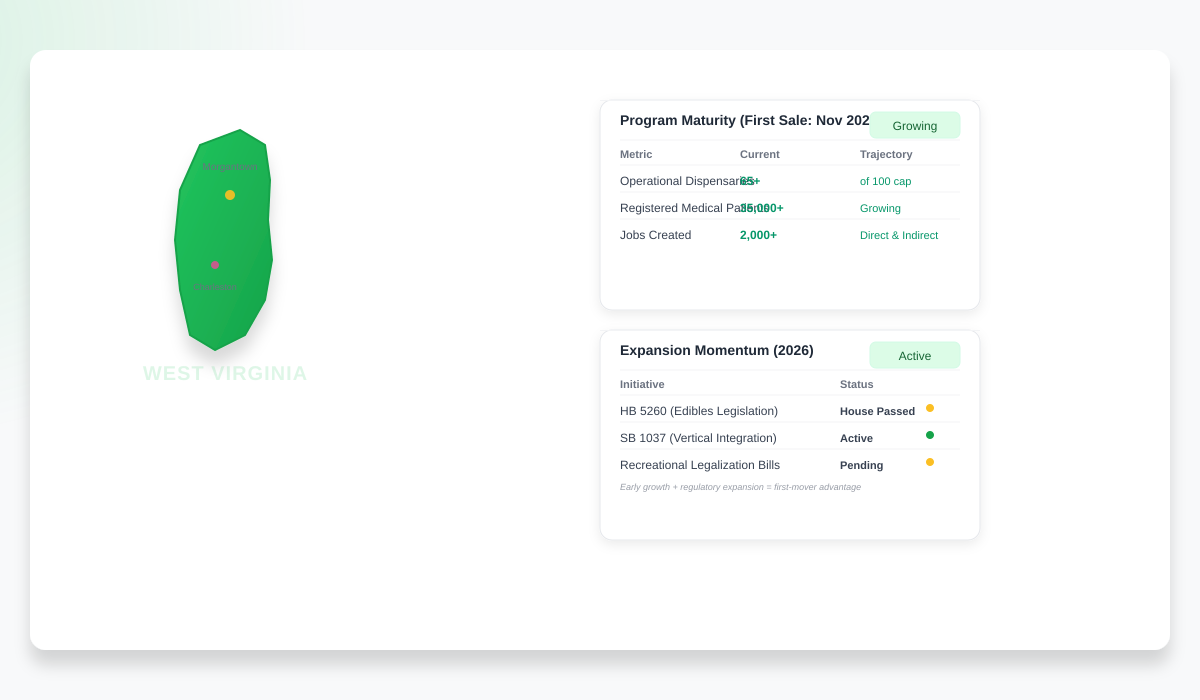
West Virginia legalized medical cannabis in 2017, but the market really began in November 2021 when the first dispensary opened in Morgantown. A few years later the program has matured: roughly 65+ dispensaries operating, 35,000+ registered patients, and an active grower/processor supply chain. And it isn’t standing still — in March 2026 the House passed HB 5260 to allow dispensary edibles, which would bring West Virginia in line with almost every other medical state. If you’re opening or scaling here, you’re entering a program in active growth: expanding access, expanding product formats, and still early enough to capture real market share before saturation. IndicaOnline handles the complexity: patient verification, 30-day-supply enforcement, edibles-ready product tracking, Metrc seed-to-sale compliance, vertical-integration support, and the documentation the Office of Medical Cannabis expects.
West Virginia market snapshot — as of 2026
- Legalized 2017 (SB 386); first dispensary sale November 12, 2021
- Regulated by the West Virginia Office of Medical Cannabis (OMC); medical-only (recreational remains illegal)
- Seed-to-sale tracked in Metrc (with a patient “active flag” verified before each sale)
- ~65+ dispensaries and ~35,000+ patients; permits capped (10 growers, 10 processors, up to 100 dispensaries)
- 10% tax on dispensary gross receipts; medical cannabis is exempt from the 6% state sales tax
- Patients need a physician certification and a state OMC ID card; 30-day supply (physician-determined)
- Flower allowed for vaporization (smoking prohibited); edibles pending via HB 5260
West Virginia’s program is young and actively expanding. Last updated: 2026.
Selling Medical Cannabis in West Virginia: What Operators Need to Know
West Virginia legalized medical cannabis when Governor Jim Justice signed Senate Bill 386 in April 2017. Regulatory development and licensing delays pushed the first dispensary sale to November 12, 2021. Since then it’s become a functional, growing market with clear demand.
From Legalization to First Sale (2017–2021)
SB 386 passed with strong bipartisan support, but the program didn’t launch until late 2021 due to rulemaking, licensing logistics, and banking barriers. Once it opened, growth was fast — roughly 65+ dispensaries and 35,000+ patients within a few years — reflecting pent-up demand.
An Early-Growth Market (Not Saturated)
Unlike mature markets with hundreds of dispensaries (California, Colorado), West Virginia’s ~65 dispensaries serve a state of about 1.7 million. That’s a balanced early-growth market: new entrants can still build meaningful share and patient loyalty without overwhelming saturation.
Qualifying Conditions
West Virginia recognizes a broad list: cancer, HIV/AIDS, ALS, Parkinson’s disease, multiple sclerosis, spinal-cord damage, epilepsy, intractable seizures, neuropathies, Huntington’s disease, Crohn’s disease, PTSD, sickle-cell anemia, severe chronic or intractable pain, and terminal illness. Practitioners certify patients for conditions meeting the statutory framework.
Physician Certification & State ID Card
Patients first obtain a written certification from a licensed West Virginia practitioner, then register with the Office of Medical Cannabis to receive a state medical cannabis ID card (an ID-card fee applies, waivable for hardship). Dispensaries verify the patient’s certification, ID, and active status before every sale — IndicaOnline automates this at checkout.
30-Day Supply Limits
Patients may purchase a 30-day supply as determined by their physician (with a flower/THC equivalency for non-flower products). IndicaOnline tracks each patient’s cumulative purchases against the limit and blocks over-limit sales.
Product Formats (Flower for Vaporization; Edibles Pending)
West Virginia allows pills, oils, gels, creams, ointments, tinctures, liquids, and dry-leaf/flower (added by SB 339 in 2020) — but flower is for vaporization only; smoking is prohibited, and dispensaries currently cannot sell edibles. In March 2026, the House passed HB 5260 to allow dispensary edibles (Senate consideration pending). If it becomes law, edibles will meaningfully expand your product mix. IndicaOnline is built to switch edibles on immediately — THC-per-serving/package tracking, packaging compliance, and multi-format purchase-limit enforcement.
Vertical Integration Permitted
A single entity may hold permits across cultivation, processing, and retail, enabling grower-processor-retailer operations and a tighter supply chain. IndicaOnline supports vertical-integration workflows — cultivation-to-processing-to-retail tracking, inventory transfers, and integrated reporting.
Seed-to-Sale Tracking on Metrc
West Virginia mandates Metrc for seed-to-sale tracking; all product movement is logged in real time, and each patient’s status carries an “active flag” that must be confirmed before a sale. IndicaOnline integrates directly with Metrc to automate reporting and eliminate manual errors.
Taxes: A 10% Dispensary Tax (No General Sales Tax)
This is a common point of confusion, so get it right: West Virginia imposes a 10% tax on the gross receipts a dispensary receives from medical cannabis sales — a cannabis-specific tax — and medical cannabis is exempt from the state’s 6% general sales tax. IndicaOnline applies the 10% tax correctly at checkout and exports clean reports.
Capped Licensing Prevents Oversaturation
The program is capped: 10 grower permits, 10 processor permits, and up to 100 dispensary permits distributed across state senate districts, awarded through a competitive, merit-based process. The cap protects operators from unlimited proliferation and creates scarcity value for licenses.
Banking Is Available
West Virginia authorized state financial institutions to serve cannabis operators, so licensed businesses can access banking — reducing cash-handling risk and complexity.
Legislative Momentum
Recreational cannabis remains illegal in West Virginia, and the state is one of the few without decriminalization (non-medical possession carries penalties; medical patients with valid certifications are protected). Adult-use and reform bills continue to be introduced and debated, but none has passed, and they face headwinds in the legislature. Operators should plan around the current medical-only framework while watching the reform conversation.
West Virginia Dispensary License: Costs & Requirements at a Glance
| Item | Detail |
|---|---|
| Licensing authority | West Virginia Office of Medical Cannabis (OMC) |
| License type | Medical cannabis dispensary permit |
| Number of licenses | Up to 100 dispensary permits (across senate districts); 10 growers, 10 processors |
| Licensing method | Competitive, merit-based application |
| Dispensary application fee | ~$2,500 (non-refundable); confirm current amount with OMC |
| Dispensary registration/permit fee | ~$10,000 (grower/processor higher); confirm with OMC |
| License validity | Annual; renew yearly |
| Residency | West Virginia resident or majority WV-owned entity |
| Capitalization | Substantial (six figures); confirm current thresholds with OMC |
| Vertical integration | Permitted (one permit each: grower, processor, retailer) |
| Seed-to-sale | Metrc (mandatory, real-time) |
| Patient requirement | Physician certification and state OMC ID card |
| Supply limit | 30-day supply per patient (physician-determined) |
| Product formats | Flower (vaporization), oils, tinctures, topicals, patches; edibles pending (HB 5260) |
| Taxes | 10% tax on dispensary gross receipts; exempt from the 6% state sales tax |
Fees and requirements are subject to OMC updates — check the WV OMC (medcanwv.org / sos.wv.gov) for current information.
How to Apply for a West Virginia Dispensary License
West Virginia’s process is competitive and merit-based.
Step 1: Confirm eligibility and residency. Be a WV resident or majority-WV-owned entity, pass background checks, and demonstrate adequate capitalization. Review current OMC requirements and deadlines.
Step 2: Identify a compliant location. Comply with local zoning (commercial zones), check municipal ordinances (some cities restrict cannabis retail), obtain local approval if required, and secure site control (lease or deed).
Step 3: Develop your operational plan covering management/org structure; site plan and security (cameras, alarms, controlled access); inventory procedures; staff training and compliance; patient verification (certification, ID, age); recordkeeping and audits; Metrc integration; patient education; and a vertical-integration plan if applicable.
Step 4: Assemble your application package — proof of residency; entity documentation; owners/managers/stakeholders with background authorizations; proof of capitalization; site control; local zoning approval; operations, security, and compliance plans; and Metrc integration documentation.
Step 5: Submit to OMC through the application portal. OMC reviews for completeness and merit; allow roughly 60–180 days.
Step 6: Await approval and inspection. On selection, build out, train staff, activate security, and pass OMC inspection; then receive your permit and purchase wholesale inventory.
Step 7: Launch retail operations. Train all staff on patient verification, supply-limit enforcement, compliance documentation, and Metrc procedures before your first sale.
How IndicaOnline Supports West Virginia Dispensaries
Patient Verification. Every sale requires a valid physician certification and active patient status. IndicaOnline verifies certification, ID, and Metrc “active flag,” flagging expired or inactive patients and preventing unauthorized sales.
30-Day Supply Enforcement. IndicaOnline tracks cumulative purchases per patient, enforces the 30-day limit, alerts staff as patients approach it, and builds audit trails.
Edibles-Ready Product Support. As HB 5260 moves through the Senate, IndicaOnline is ready to switch edibles on instantly — THC-per-serving/package tracking, packaging compliance, and multi-format purchase-limit enforcement — no system overhaul.
Metrc Real-Time Integration. Every sale, adjustment, and inventory event syncs to Metrc automatically, keeping your records aligned with OMC and simplifying audits.
Vertical-Integration Support. Hold cultivation + processing + retail permits? IndicaOnline manages all segments in one system, syncing data across your license portfolio.
Tax Automation. IndicaOnline applies West Virginia’s 10% dispensary tax correctly and reflects the medical exemption from the 6% sales tax — no manual math.
OMC-Ready Compliance Documentation. Transaction logs, staff training records, patient verification records, inventory reports, and Metrc sync confirmations that meet OMC inspection standards.
Market & Multi-Location Analytics. Real-time sales, product-mix, and patient insights to help you capture share as the patient base grows — plus multi-location sync with per-site audit trails if you expand.
Ready to Launch Your West Virginia Dispensary?
West Virginia’s medical program is growing: an expanding patient base (~35,000+), a dispensary network approaching its cap (~65 of 100), and legislation that would broaden product formats (edibles). For new operators, the window is attractive — early enough to build share before saturation, with a clear regulatory framework and available banking.
Success takes operational excellence, strong physician relationships, patient education, and compliance rigor. IndicaOnline removes the operational friction — patient verification, supply-limit enforcement, Metrc integration, edibles readiness, and OMC documentation — so you can focus on patients and growth.