Cannabis POS Software for South Dakota Dispensaries
Run a fully compliant South Dakota medical cannabis dispensary with IndicaOnline — the POS system built for South Dakota’s voter-approved program, strict regulatory compliance, and the unique challenges of operating in a politically contested market where legislative threats require operational excellence and ironclad documentation.
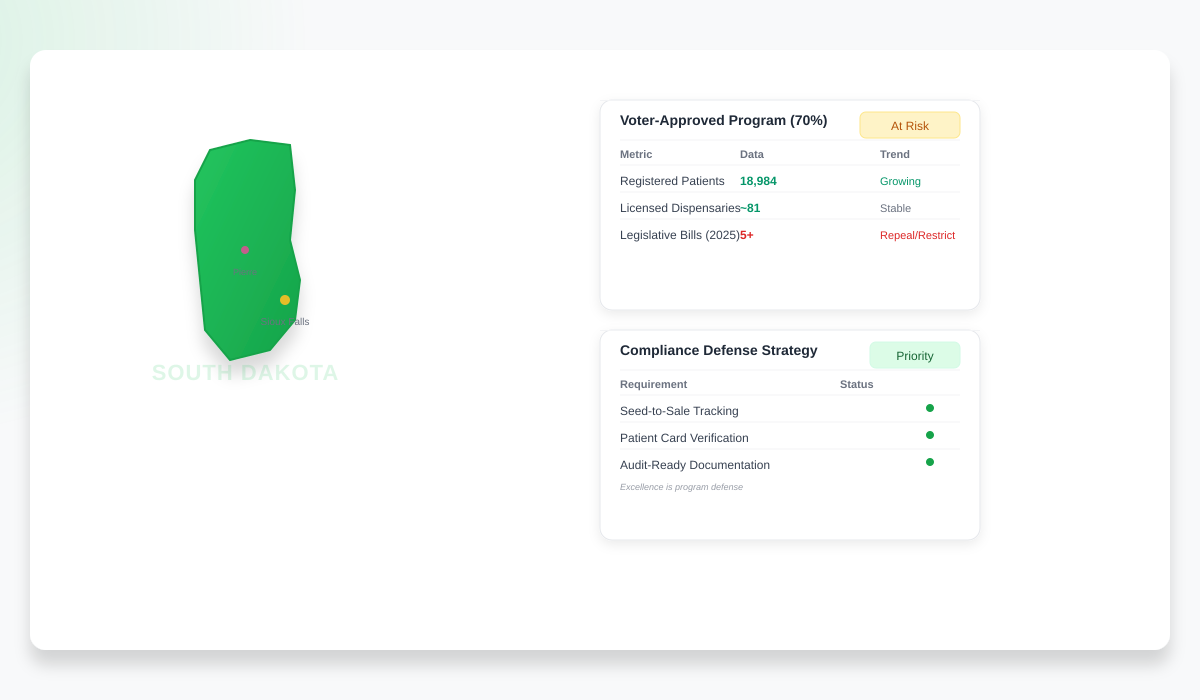
South Dakota’s medical cannabis program represents a rare victory for patient access in a conservative state: in November 2020, voters approved Measure 26 with 70% support, establishing one of the nation’s strictest but most defensible medical frameworks. The program launched legal dispensary sales in July 2022 and has grown to serve 18,984+ registered patients (as of May 2026) through approximately 81 licensed dispensaries, with 219 approved practitioners. However, the program faces ongoing legislative threats from opponents who have repeatedly attempted to repeal or restrict it. As of April 2026, South Dakota faces multiple bills aimed at dismantling or severely limiting the program — requiring operators to maintain exceptional compliance, transparent practices, and detailed operational documentation. If you’re opening or scaling a South Dakota dispensary, you’re operating in a market with genuine patient demand and voter mandate, but also political vulnerability. IndicaOnline handles the regulatory complexity: seed-to-sale compliance, patient card verification, purchase limit enforcement (3 oz per 14 days), home cultivation integration, detailed audit documentation, and the ironclad record-keeping required to demonstrate program legitimacy and safety.
Selling Medical Cannabis in South Dakota: What Operators Need to Know
South Dakota legalized medical cannabis through Measure 26, a voter-approved amendment to the state constitution in November 2020. The program became operational in July 2022 with legal dispensary sales. The South Dakota Department of Health (SDOH) administers the program through a fee-based model (rather than general-fund appropriations), with annual licensing fees of $9,000 per establishment as of 2024 (increased 70% from $5,310 to cover rising administrative costs).
Voter-Approved Program (70% Support in 2020). Unlike legislatively-passed programs, South Dakota’s medical cannabis framework comes from direct voter mandate — 70% of voters approved Measure 26 in November 2020. This is a significant political asset, but also a target. Opposition lawmakers have introduced multiple bills since 2022 attempting to repeal or restrict the program (HB 1101 in 2024 proposed full repeal; HB 1055 and HB 1209 in 2025 sought additional restrictions). Operationally, this means maintaining exceptional compliance and transparent documentation to defend the program’s legitimacy and public health outcomes.
Growing Patient Base (18,984+ Cards as of May 2026). South Dakota’s medical cannabis patient base has grown from approximately 14,843 patients in FY2025 to 18,984+ by May 2026. This represents sustained patient demand despite political headwinds. The program allows patients 18+ to register independently; minors may participate with parental/guardian consent and must use a registered caregiver to purchase. As of May 1, 2026, there were 219 approved practitioners and 577 registered caregivers.
Approximately 81 Licensed Dispensaries (FY2025-FY2026). As of FY2025, the SDOH reported 81–118 licensed dispensaries operating statewide (numbers fluctuate due to applications, closures, and enforcement actions). This represents a mature retail network serving a state with modest population (~887,000). The market is neither oversaturated nor undersupplied, but space for new entrants exists in underserved regions.
Strict Seed-to-Seed Tracking (State-Mandated). South Dakota requires all medical cannabis establishments to use an official seed-to-sale tracking system. All product movement — from cultivation through sale — must be logged in real-time. IndicaOnline integrates with South Dakota’s tracking system to automate compliance reporting and eliminate manual entry errors. Non-compliance with tracking requirements triggers regulatory action, including fines and license suspension.
Home Cultivation Permitted (Up to 4 Plants). Unlike some states, South Dakota allows registered patients to home-cultivate up to 2 flowering plants and 2 immature plants. This creates an operational dynamic where dispensaries compete against patient home-grows. Dispensaries must emphasize convenience, quality, product selection, and patient education to maintain market share against home cultivation competition.
Patient Registry Card Required (Mandatory Verification). Every purchase requires verification that the customer holds an active South Dakota medical cannabis registry ID card. Patients must also present photo ID and their written certification from a healthcare practitioner. IndicaOnline integrates with the state registry to verify card status at checkout — any sale to an unregistered or invalid-card holder is a compliance violation and grounds for enforcement action.
Purchase Limits (3 oz Flower per 14 Days). Registered patients can possess and purchase up to 3 ounces of flower every 14 days, along with additional allowances for infused products and cultivated plants as permitted by the SDOH. IndicaOnline enforces these limits at checkout, tracking cumulative purchases per patient and blocking sales that exceed limits — protecting your license and preventing patient over-purchase.
Qualifying Conditions (Broad but Specific). South Dakota recognizes qualifying conditions including cancer, HIV/AIDS, hepatitis C, ALS, Crohn’s disease, PTSD, cachexia, severe chronic pain, severe nausea, seizures, and severe persistent muscle spasms. Practitioners have discretion to recommend patients for conditions meeting the statutory framework (likely to receive therapeutic or palliative benefit). The list is broad enough to serve a meaningful patient population but specific enough to prevent frivolous certification.
Non-Resident Patients Allowed (But Not Reciprocal). Out-of-state medical cannabis cards are not accepted in South Dakota. However, non-resident patients can apply to the program as “non-resident patients” and purchase from licensed dispensaries if they meet qualifying conditions. This creates an additional revenue opportunity, especially for dispensaries near state borders or in tourist areas.
No Recreational Market (Medical-Only). South Dakota’s program is strictly medical. Recreational cannabis is illegal, with possession penalties of up to 1 year jail and $250 fine for under 2 oz, and felony charges for over 2 oz. A 2024 recreational ballot measure failed. As of May 2026, there is no legislative movement toward adult-use legalization.
Regulatory Risk & Political Vulnerability. The program faces ongoing legislative threats. HB 1101 (2024) proposed complete repeal; HB 1055, HB 1209, and other 2025 bills sought additional restrictions (two-physician signatures, strengthened practitioner relationship requirements, etc.). While the program survives due to voter mandate, operators must maintain exemplary compliance and transparent documentation to demonstrate the program’s safety, legitimacy, and public health value. Any compliance failures or negative incidents create ammunition for opponents.
Annual License Fee Increase (70% Hike in 2024). Annual establishment license fees increased from $5,310 to $9,000 in 2024 to cover rising administrative costs. This reflects the regulatory burden and SDOH’s investment in inspections, enforcement, and program administration. Budget accordingly for annual renewal costs.
South Dakota Dispensary License: Costs & Requirements at a Glance
| Item | Detail |
|---|---|
| Licensing authority | South Dakota Department of Health (SDOH) |
| License type | Medical cannabis dispensary registration certificate |
| Number of licenses | ~81 licensed dispensaries (FY2025–FY2026); no statutory cap |
| License selection method | Application-based; SDOH reviews for compliance |
| Application fee | Set by SDOH; typically $500–$2,000 (varies by establishment type) |
| Annual license fee | $9,000 as of 2024 (increased 70% from $5,310) |
| License validity | Annual; must renew yearly |
| Residency requirement | South Dakota resident preferred (check current SDOH guidance) |
| Capitalization | Adequate capital required; typically $100,000–$300,000 |
| Seed-to-sale integration | Mandatory; real-time integration with state tracking system |
| Patient verification | Mandatory registry card check at checkout |
| Background checks | Required for all owners and key employees |
| Inspection frequency | Routine inspections (112 conducted in FY2025); frequency varies |
| Buffer zones | Local ordinance compliance; typically 1,000 ft from schools |
| Local zoning | Commercial or permitted zones; varies by city/county |
| Sales tax | Regular South Dakota sales tax (6% state + local, varies by county) |
| No cannabis excise tax | South Dakota does not impose a cannabis-specific excise tax |
License fees and requirements are subject to SDOH updates. Check medcannabis.sd.gov for current information.
How to Apply for a South Dakota Dispensary License
South Dakota’s application process is relatively straightforward, but regulatory compliance is stringent and ongoing.
Step 1: Confirm you meet baseline requirements. You must be a South Dakota resident (check current SDOH guidance on residency). You must have no disqualifying criminal record (felony drug convictions typically disqualify; check SDOH criteria). You must demonstrate adequate capitalization (typically $100K–$300K).
Step 2: Identify a compliant location. Your retail location must comply with local zoning ordinances (commercial zones preferred). Check with your city or county planning department to confirm cannabis retail is permitted. Many municipalities require a local license or conditional-use permit before state application. Typical buffer zones are 1,000 feet from schools and daycares (varies by locality).
Step 3: Secure site control. You must have a lease or deed demonstrating control of the proposed retail location. The location must be exclusively for cannabis retail (no shared tenants for cannabis purposes). Landlord consent and lease terms allowing cannabis retail are essential.
Step 4: Obtain local authorization. Many cities and counties require local licensing or approval before state application. Apply for local approval first; a local license or letter of authorization is typically required for the state application.
Step 5: Assemble your state application. South Dakota SDOH dispensary applications typically require:
- Proof of South Dakota residency (ID, utility bills, lease, etc.)
- List of all owners, managers, and financial stakeholders with background authorizations
- Proof of adequate capitalization (bank statements, investor letters, etc.)
- Site control documentation (lease or deed)
- Local authorization or license approval
- Detailed operations plan (hours, staffing, security, inventory procedures, Metrc integration plan)
- Security and surveillance plan (camera placement, staff protocols, cash handling, product storage)
- Compliance certification (statement confirming understanding of SDOH regulations)
- Seed-to-sale system setup documentation (how you’ll integrate with state tracking)
Step 6: Submit application to SDOH. Submit completed application through medcannabis.sd.gov or as directed by SDOH. Include all required documentation, fees, and certifications. SDOH reviews applications for completeness and compliance with regulations.
Step 7: Await approval and inspection. SDOH reviews your application (timeline varies, typically 30–90 days). Upon preliminary approval, SDOH conducts an inspection of your location, security systems, and operational readiness. Address any deficiencies. Once inspection passes, you receive your registration certificate.
Step 8: Integrate seed-to-sale tracking and staff training. Upon license award, activate your seed-to-sale account with the state system. Train all staff on patient verification, purchase limits, product handling, regulatory compliance, and SDOH inspection protocols. Conduct a compliance walkthrough to ensure your location, signage, and operations meet state standards. Once ready, you can begin purchasing wholesale inventory and opening for sales.
How IndicaOnline Supports South Dakota Dispensaries
South Dakota’s politically contested regulatory environment and strict compliance requirements demand a POS that handles patient verification, purchase limit enforcement, and detailed documentation with precision. Operational excellence is not just about efficiency — it’s about program legitimacy and defense against legislative threats.
Seed-to-Seed Tracking Integration (Real-Time). IndicaOnline integrates with South Dakota’s seed-to-sale tracking system in real-time. Every sale, adjustment, and inventory event syncs automatically. No manual entry, no data lag — your records are always aligned with state records. This is critical in a politically vulnerable environment: your compliance data is transparent, auditable, and defensible.
Patient Card Verification (Mandatory at Checkout). IndicaOnline integrates with the SDOH registry to verify that every customer’s medical cannabis card is active and valid before completing a sale. System checks patient status, confirmation status, and eligibility. Any attempt to sell to an unregistered or expired-card holder is blocked — protecting your license and preventing regulatory violations.
Purchase Limit Enforcement (3 oz per 14 Days). IndicaOnline tracks cumulative purchases per patient and enforces South Dakota’s 3-ounce-per-14-days purchase limit. System blocks over-limit sales and alerts staff when patients approach their limit. This prevents patient over-purchase and protects your license from enforcement action.
Home Cultivation Integration (Operational Context). South Dakota allows home cultivation (up to 4 plants per patient). IndicaOnline doesn’t prevent home-growing, but your POS can highlight dispensary advantages (convenience, product selection, quality assurance, patient education) to maintain market share against home cultivation competition.
Detailed Audit Documentation (Compliance Armor). SDOH audits are routine (112 conducted in FY2025). IndicaOnline maintains transaction logs, staff training records, inventory reports, waste documentation, patient verification records, and seed-to-sale sync confirmations that meet SDOH inspection standards. When regulators visit or legislators demand proof that the program operates safely, you have audit-ready documentation.
Non-Resident Patient Tracking (Revenue Opportunity). IndicaOnline flags and tracks non-resident patient purchases separately, maintaining audit trails and compliance documentation for this customer segment. Out-of-state visitors and border-state patients can become an additional revenue stream.
Sales Tax Automation (South Dakota Compliant). South Dakota does not impose a cannabis-specific excise tax — only regular state and local sales tax (6% state + local variation by county). IndicaOnline calculates the correct rate based on location and applies it automatically. No manual tax entry required.
Staff Compliance Training & Onboarding. New market, strict regulations, and political pressure require exceptional staff training. IndicaOnline includes onboarding modules covering SDOH rules, seed-to-sale basics, patient card verification, purchase limit enforcement, and compliance documentation. Your team gets compliant faster.
Regulatory Transparency & Defensibility. In a politically contested market, transparency is an asset. IndicaOnline’s comprehensive logging and audit trails demonstrate that your operation is compliant, safe, and legitimate — ammunition against program opponents and evidence for supporters.
Multi-Location Support (If Applicable). If you operate multiple dispensaries, IndicaOnline syncs inventory, seed-to-sale reports, and compliance documentation across all sites. Centralized oversight with per-location audit trails.
Ready to Launch Your South Dakota Dispensary?
South Dakota’s medical cannabis program operates under voter mandate with 70% public support, but faces ongoing political threats. This creates both opportunity and risk. The market has sustained patient demand (18,984+ cards as of May 2026) and room for new operators in underserved regions. However, success requires operational excellence and ironclad compliance — your exemplary practice is not just good business, it’s defense of a voter-approved program.
IndicaOnline removes operational friction and compliance risk, letting you focus on patient service while we handle seed-to-sale integration, patient verification, purchase limit enforcement, detailed audit documentation, and regulatory transparency. In a politically contested market, your best defense is exemplary operations.
South Dakota’s program has patient demand. Operate with excellence.