

Cannabis POS Software for Virginia Dispensaries
Run a fully compliant Virginia medical or adult-use cannabis dispensary with IndicaOnline — the POS system built for Virginia’s transformational 2027 market launch, decoupled licensing model, 350-license opportunity, and the seismic shift from a $2.4 billion illegal market to regulated retail.
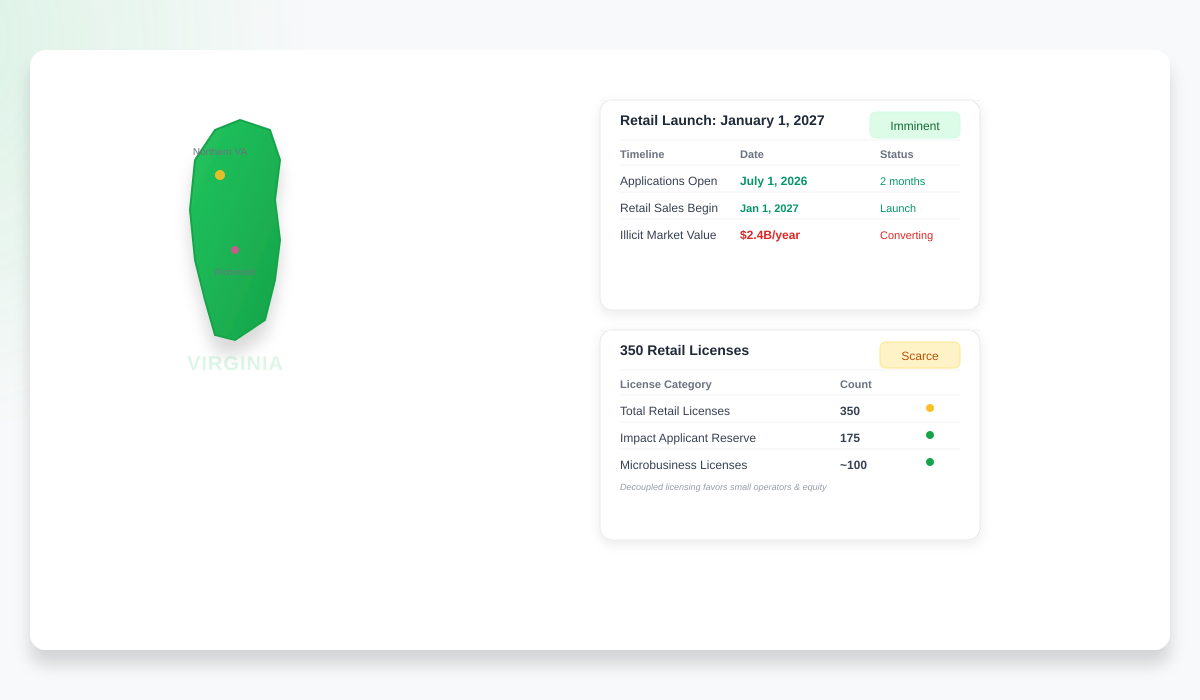
Virginia’s cannabis story is one of extraordinary opportunity meeting extraordinary delay. Since July 2021, adults have been able to legally possess up to 1 ounce and grow 4 plants per household — but there has been nowhere legal to buy. The result: an estimated $2.4 billion in annual cannabis sales, 99% flowing through unregulated channels. For five years, lawmakers have pushed for a retail framework, only to face repeated vetoes from former Republican Governor Glenn Youngkin. That changed in November 2025 with the election of Democrat Abigail Spanberger. In February 2026, the Virginia House and Senate passed historic adult-use cannabis legislation (HB 642 / SB 542). The framework is revolutionary: 350 retail licenses statewide (strict cap to prevent over-saturation), decoupled licensing (retailers, cultivators, and manufacturers can specialize rather than vertically integrate), 50% of licenses reserved for “impact applicants” (economically disadvantaged persons, social equity priority), and applications opening July 1, 2026, with retail sales launching January 1, 2027. Existing medical dispensaries (23 licensed, serving 104,000+ patients) can transition to adult-use with a $5 million one-time fee. For new market entrants, this is the largest regulatory window Virginia cannabis has ever seen. If you’re opening or transitioning a Virginia dispensary, you’re entering a market with pent-up demand ($2.4B currently flowing to illicit operators), clear regulatory framework, and a Democratic trifecta supporting implementation. IndicaOnline handles the complexity: medical-to-adult-use transition workflows, decoupled licensing compliance, purchase limit enforcement (2.5 oz for adult-use, no cap for at-home possession), inventory management for multi-license operators, CCA compliance documentation, and the audit trails required in Virginia’s compliance-first regulatory environment.
Selling Cannabis in Virginia: What Operators Need to Know
Virginia decriminalized cannabis possession in 2020 and legalized possession in 2021, but legal sales remained prohibited. For five years, a Democratic legislature repeatedly passed adult-use bills that were vetoed by Republican Governor Glenn Youngkin. That gridlock ended in November 2025 with Spanberger’s election. In February 2026, the Virginia House and Senate passed HB 642, historic bipartisan legislation establishing Virginia’s first retail cannabis market. Governor Spanberger has committed to signing the bill.
Five Years of Legal Possession, Zero Legal Sales. Since July 1, 2021, Virginia adults can legally possess up to 1 ounce and grow 4 plants per household. Medical patients have accessed cannabis through 23 licensed medical dispensaries (104,000+ patients). But recreational sales remained illegal — creating a massive illicit market estimated at $2.4 billion annually, 99% of all cannabis consumed in Virginia. Illicit operators filled the void. Now, that void is closing.
The 2025 Election Changed Everything. Former Governor Glenn Youngkin, a Republican, vetoed multiple cannabis bills in 2024 and 2025. His stated opposition (“I don’t think Virginia should legalize marijuana”) was the primary roadblock. In November 2025, Democrat Abigail Spanberger won the governorship, sweeping Democrats into a “trifecta” (House, Senate, Governor). Spanberger has publicly supported cannabis legalization. With political opposition removed, the legislature fast-tracked adult-use legislation.
HB 642: A Historic 350-License Framework (Passed Feb. 2026). HB 642, passed by the House (65-32) and Senate (21-19) in February 2026, creates Virginia’s first adult-use retail market. Key features:
- 350 retail licenses (strict statewide cap to prevent over-saturation)
- Decoupled licensing (retailers, cultivators, manufacturers can specialize instead of vertically integrating)
- 50% equity reserve (175 licenses reserved for “impact applicants” — economically disadvantaged, social equity priority)
- Medical conversion option (existing 5 medical licensees operating 23 dispensaries can convert to adult-use by paying $5 million one-time fee per licensee)
- Up to 100 microbusiness licenses (for hemp operators and “impact licensees”; vertically integrated cultivation, processing, onsite retail, delivery)
- Up to 5 large cultivation licenses (for existing hemp licensees; fee $500,000)
- Applications open July 1, 2026 (CCA begins accepting retail license applications)
- Retail sales launch January 1, 2027 (first adult-use cannabis sales in Virginia)
Decoupled Licensing (Decentralization Model). Unlike traditional cannabis markets where large vertical operations dominate, Virginia’s decoupled system allows businesses to specialize in one or more segments: retail-only, cultivation-only, manufacturing-only, or testing-only. This architecture favors small, Virginia-based operators over multi-state corporations. A farmer growing hemp can transition to cultivating cannabis; a processor can focus on manufacturing without owning retail; a retailer can source from multiple cultivators. This model is more efficient and allows for smaller, community-focused operations.
Medical Cannabis: 23 Dispensaries, 104,000+ Patients. Virginia’s medical program remains operational. Five vertically integrated “pharmaceutical processors” hold licenses to cultivate, manufacture, and dispense medical cannabis. These licensees operate up to 6 dispensary locations each, totaling 23 medical dispensaries statewide. As of May 2026, 104,000+ registered patients access medical cannabis. Medical patients do not need a state registration card — only a written certification from a healthcare practitioner and a valid photo ID. Medical pricing is typically lower than adult-use pricing (lower tax burden, specialized pricing strategies).
Adult-Use Possession Limits & Tax Treatment. Once sales launch January 1, 2027, adults 21+ can purchase and possess up to 2.5 ounces of cannabis flower or equivalent. Edible cannabis products are capped at 10 milligrams THC per serving and 100 milligrams per package. At-home personal possession has no statutory cap (legal to possess more than 2.5 oz if purchased through non-retail channels before legalization; personal growth up to 4 plants per household remains legal). Adult-use sales will be subject to state excise tax (rate to be determined by CCA; expected 10–20%) plus standard Virginia sales tax (varies by locality, typically 5.3–6%).
No Qualifying Conditions (Medical). Unlike most medical programs, Virginia’s medical cannabis framework has no formal “qualifying conditions” list. Any healthcare practitioner can recommend cannabis for any patient they believe would benefit. This creates a broad medical patient base and fewer barriers to access for medical patients.
Statewide Program (No Local Opt-Out). Unlike states where municipalities can ban cannabis retail, Virginia’s program is statewide — localities cannot opt out. However, localities can establish local regulations (zoning, distance from schools, operating hours, etc.). This ensures market access across the state and prevents the over-concentration in limited areas that harms licensed market competitiveness (e.g., California, where 57% of cities ban cannabis retail and only 38% of sales occur through licensed channels).
Estimated $2.4 Billion Illegal Market Converting to Legal. Virginia’s illegal cannabis market is estimated at $2.4 billion annually. With retail legalization, this revenue stream is expected to shift to licensed operators. Per-capita consumption is high (mature illicit customer base); retail legalization is expected to canalize illicit buyers into licensed dispensaries. Early licensees will capture the highest market share and consumer loyalty.
Democratic Trifecta & Implementation Certainty. With Gov. Spanberger (D), Democratic House majority, and Democratic Senate, the political environment for cannabis implementation is favorable. Opposition to legalization has largely disappeared. CCA is expected to finalize regulations and open applications on schedule (July 1, 2026).
Virginia Dispensary License: Costs & Requirements at a Glance
| Item | Detail |
|---|---|
| Licensing authority | Virginia Cannabis Control Authority (CCA) |
| License type | Retail (standard), microbusiness (vertically integrated), or medical conversion |
| Number of licenses | 350 retail licenses (strict cap); up to 100 microbusiness; up to 5 large cultivation |
| License selection method | Merit-based application review + potential lottery for retail; microbusiness prioritizes hemp operators |
| Application fee | ~$1,000–$5,000 (subject to CCA finalization) |
| Annual license fee | ~$5,000–$15,000 (subject to CCA finalization) |
| License validity | Annual; must renew yearly |
| Equity reserve | 175 of 350 retail licenses (50%) reserved for “impact applicants” |
| Medical conversion fee | $5 million per existing medical licensee |
| Residency requirement | Virginia resident preferred; Virginia-based operations favored |
| Capitalization | $100,000–$500,000+ depending on scope |
| Local approval | Required; local zoning compliance, no state-level buffer zones mandated (local rules apply) |
| Background checks | Required for all owners and key employees |
| Labor agreement | All licensees must enter Labor Peace Agreement |
| Sales tax | State excise tax (rate TBD) + standard Virginia sales tax (5.3–6.5% varies by county) |
| Application window opens | July 1, 2026 |
| First retail sales | January 1, 2027 |
License fees, application requirements, and timelines are subject to CCA finalization. Check cca.virginia.gov for updates.
How to Apply for a Virginia Adult-Use Retail License
Virginia’s application process begins July 1, 2026, with the first retail sales launching January 1, 2027. Here’s the pathway:
Step 1: Determine your applicant status. Are you applying as a standard retail licensee, microbusiness (if hemp operator), impact applicant (economically disadvantaged), or medical conversion (if existing licensee)? Each category has different application pathways, fee structures, and timelines. Standard retail and impact applicants compete for the 350 retail licenses; impact applicants have 175 licenses reserved. Microbusiness applicants compete for up to 100 licenses with priority to hemp operators.
Step 2: Confirm Virginia residency and business structure. Virginia applicants are strongly favored. Demonstrate Virginia residency (ID, property ownership, voter registration, etc.). Choose your business entity (LLC, corporation, etc.) and register with Virginia Secretary of State.
Step 3: Identify a compliant retail location. Your location must comply with local zoning (commercial districts preferred). Check local municipal ordinances for cannabis retail requirements — some cities allow retail; others restrict it. Obtain local zoning approval or conditional-use permit if required. Secure site control through a lease or deed. Ensure exclusive control for cannabis retail (no shared cannabis tenants).
Step 4: Develop your operational plan. Applications require detailed operations plans covering:
- Management and organizational structure
- Site plan and security design
- Inventory management procedures
- Staff training and compliance protocols
- Customer verification procedures (age, purchase limits)
- Record-keeping and audit procedures
- Community outreach and social equity integration (if applicable)
- Labor Peace Agreement (required for all licensees)
Step 5: Assemble your application package. Applications (due by deadline announced by CCA, expected fall 2026) must include:
- Proof of Virginia residency
- Business entity documentation
- List of owners, managers, financial stakeholders with background authorizations
- Proof of capitalization (bank statements, investor letters, lines of credit)
- Site control documentation (lease or deed)
- Local zoning approval or conditional-use permit
- Operations plan (detailed)
- Security and surveillance plan
- Compliance certification
- Labor Peace Agreement documentation
- Social equity certification (if applying as impact applicant)
Step 6: Submit application to CCA. Submit through CCA portal (expected online portal to open July 2026). Applications may undergo merit-based review followed by random lottery draw (method subject to CCA finalization). Prioritization tiers: impact applicants compete in their reserved pool; standard applicants compete in open pool; microbusiness applicants compete for up to 100 licenses.
Step 7: Await approval, inspection, and activation. Upon selection, you have a defined period (expected 6–9 months) to build out your retail location, complete training, activate security systems, and pass CCA inspection. Once approved, you receive your provisional license and can begin purchasing wholesale inventory and preparing for retail launch.
Step 8: Launch retail sales (January 1, 2027). Licensed retailers can legally begin adult-use cannabis sales on January 1, 2027, once retail supply is available from licensed cultivators and manufacturers. Medical dispensaries serving 104,000+ patients remain operational; new adult-use retailers build a parallel network.
How IndicaOnline Supports Virginia Dispensaries
Virginia’s transition from a $2.4 billion illegal market to a regulated 350-license retail framework requires a POS built for medical-to-adult-use conversion, decoupled licensing compliance, and rapid market entry. Operational excellence is your competitive advantage.
Medical-to-Adult-Use Transition Workflows. If you’re operating a medical dispensary or transitioning from medical to adult-use, IndicaOnline supports both customer types in a single system. Medical transactions verify patient certification, apply medical pricing/tax treatment, and enforce medical-specific regulations. Adult-use transactions verify age (21+), apply adult-use pricing and excise tax, enforce 2.5-oz purchase limits, and track cumulative purchases. Staff seamlessly switches between workflows.
Decoupled Licensing Compliance (Multi-License Operators). If you hold multiple licenses (e.g., cultivation + retail, or retail + manufacturing), IndicaOnline integrates your license-specific operations. Cultivators log seed-to-sale data; manufacturers track processing; retailers manage POS sales. All data syncs across your license portfolio, simplifying multi-license operations and enabling comprehensive business intelligence.
Purchase Limit Enforcement (2.5 oz Adult-Use). IndicaOnline enforces Virginia’s 2.5-ounce purchase limit per adult-use transaction. System tracks cumulative purchases per customer and blocks over-limit sales. Edible products are capped at 10mg THC per serving and 100mg per package (IndicaOnline ensures accurate THC dosing and packaging compliance).
Excise Tax + Sales Tax Automation. Virginia will impose a state-level cannabis excise tax (rate TBD; expected 10–20%) plus standard Virginia sales tax (5.3–6.5% varies by county). IndicaOnline calculates both automatically based on product type, THC content, locality, and transaction type (medical vs. adult-use). No manual tax entry required.
Age Verification (21+ Compliance). Adult-use sales require strict age verification. IndicaOnline prompts staff to scan ID for all adult-use transactions, logs verification, and creates audit trails. This demonstrates compliance with CCA age-gating requirements and protects your license.
CCA Compliance Documentation (Audit-Ready). CCA audits will be routine. IndicaOnline maintains transaction logs, staff training records, age verification records, inventory reports, and compliance documentation that meet CCA inspection standards. When regulators visit, you have audit-ready proof of compliance.
Decoupled Licensing Records (Multi-License Support). If you hold multiple license types (cultivation, manufacturing, retail), IndicaOnline maintains separate, auditable records for each license while enabling cross-license reporting. This simplifies regulatory submissions and business management.
Labor Peace Agreement Documentation. All Virginia licensees must enter Labor Peace Agreements. IndicaOnline logs staff records, union status (if applicable), and labor compliance documentation in a centralized, auditable format.
Rapid Market Entry Optimization. January 1, 2027 is launch day for the entire Virginia market. Early retailers will capture significant customer loyalty and market share. IndicaOnline accelerates your onboarding and operational readiness, enabling you to be operational and efficient from day one. Fast checkout, real-time inventory management, and automated compliance remove operational friction.
Multi-Location Support (Future Expansion). If you expand to multiple retail locations, IndicaOnline syncs inventory, compliance documentation, and reporting across all sites. Centralized oversight with per-location audit trails.
Revenue Optimization (High-Volume Operations). Virginia’s $2.4B illicit market represents pent-up demand. IndicaOnline provides real-time sales analytics, product mix insights, pricing recommendations, and customer behavior data to help you maximize revenue and market share during the critical launch period.
Staff Training & Compliance Onboarding. New market, new regulations, new customer base. IndicaOnline includes training modules covering CCA rules, age verification, medical vs. adult-use workflows, purchase limits, excise tax treatment, and compliance documentation. Your team gets compliant and efficient faster.
Ready to Launch Your Virginia Dispensary?
Virginia’s cannabis market is on the verge of a transformation. Five years of legal possession without legal sales created a $2.4 billion illicit market. Now, with Democratic control of the legislature and governor’s office, that market is about to shift to regulated retail. January 1, 2027 is launch day for Virginia’s entire adult-use industry. The first 350 retailers to secure licenses will capture the highest market share and customer loyalty during the critical launch period.
Virginia’s decoupled licensing model favors small, Virginia-based operators and social equity applicants — not multi-state corporations. If you’re an economically disadvantaged applicant, hemp farmer transitioning to cannabis, or local business owner, Virginia’s framework was designed for you. Applications open July 1, 2026.
IndicaOnline removes operational friction and compliance risk, letting you focus on customer service and market capture while we handle medical-to-adult-use workflows, purchase limit enforcement, excise tax + sales tax automation, age verification, CCA compliance documentation, and real-time operational optimization. The market is waiting. Move fast.
Virginia’s retail market is here.