

Run a fully Metrc-compliant medical cannabis dispensary in Kentucky with IndicaOnline — the POS system built for Kentucky’s brand-new market, early-stage operations, and the unique opportunities (and challenges) of launching in 2026.
Kentucky’s medical cannabis program is one of the nation’s newest. The program took effect January 1, 2025, and the first dispensary sales began in December 2025. As of 2026, a small but growing number of dispensaries are operational, with more licenses activating throughout the year. If you’re operating or opening a Kentucky dispensary, you’re part of an emerging market with real growth potential — and real operational complexity. IndicaOnline handles Metrc compliance, inventory management, patient registry verification, and the administrative load of a nascent program.
Kentucky market snapshot — as of 2026
- Medical-only, legalized via Senate Bill 47 (signed March 30, 2023); program effective January 1, 2025; first sales December 2025
- Managed by the Office of Medical Cannabis (OMC), within the Cabinet for Health and Family Services
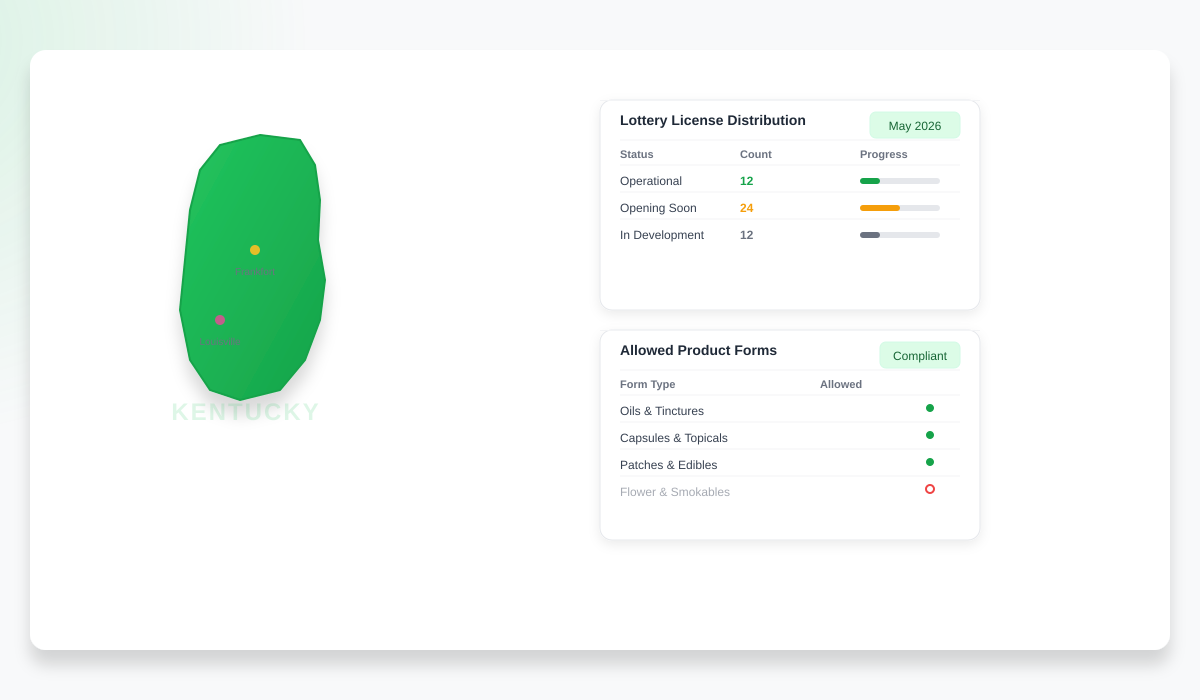
- Licenses awarded by lottery in late 2024: 48 dispensaries, 16 cultivators, 10 processors
- Seed-to-sale tracked through Metrc
- No cannabis excise tax, but the standard 6% state sales tax (plus local) applies
- Raw flower is allowed (for non-smoking use); smoking is prohibited. No home cultivation, no delivery
- Patient base growing fast — 17,000+ patient cards issued by early 2026
Kentucky’s program is new and changing quickly. Last updated: 2026.
Selling Medical Cannabis in Kentucky: What Operators Need to Know
Kentucky legalized medical cannabis on March 30, 2023, via Senate Bill 47 (SB 47), signed by Governor Andy Beshear. The law took effect January 1, 2025, launching the Kentucky Medical Cannabis Program, managed by the Office of Medical Cannabis (OMC) within the Cabinet for Health and Family Services. Unlike older medical programs, Kentucky’s infrastructure is brand-new — licensing, regulatory frameworks, and supply chains are still ramping up.
Lottery-Based Licensing
Unlike application-scored systems in other states, Kentucky used a lottery to award licenses. Applications were accepted in 2024, drawing thousands of entries, and the state awarded 48 dispensary licenses (plus 16 cultivator and 10 processor licenses). Dispensaries began opening in December 2025 and continue to come online through 2026. Each awarded license is location-specific — to operate at multiple sites, you must win a separate lottery entry for each location.
Early-Stage Inventory Challenges
The market is young. Through 2025–2026, supply-chain ramp-up is ongoing: cultivators are completing their first harvest cycles, and the first processors came online in early 2026. Product availability can be tight and wholesale bottlenecks persist, though these constraints ease as more licensees begin operating. IndicaOnline’s inventory management gives you granular visibility into limited stock and helps you optimize ordering from a still-small cultivator/processor pool.
Metrc Seed-to-Sale (Mandatory)
Kentucky contracted with Metrc for track-and-trace compliance. All licensed cannabis businesses must register and report through Metrc. IndicaOnline integrates with Metrc’s API, automating sales logging, daily inventory reconciliation, and transfer manifests — critical in a new market where regulatory scrutiny is high and manual errors carry steep penalties.
Taxes: No Cannabis Excise Tax (but Sales Tax Applies)
Kentucky did not enact a cannabis-specific excise tax — a genuine simplicity advantage over potency-tax states like Illinois. However, medical cannabis is treated as a tangible good and is subject to the standard 6% Kentucky state sales tax (plus any local option taxes). There is no medical sales-tax exemption. So while you avoid the stacked excise tiers other states impose, you still collect and remit ordinary sales tax. IndicaOnline applies the correct sales tax automatically at checkout and generates the reports you file with the Kentucky Department of Revenue.
Qualifying Conditions
Kentucky’s qualifying conditions currently include: any type or form of cancer; chronic, severe, intractable, or debilitating pain; epilepsy or intractable seizure disorder; multiple sclerosis, muscle spasms, or spasticity; chronic nausea or cyclical vomiting; and post-traumatic stress disorder — plus any additional condition the Kentucky Center for Cannabis determines appropriate. The list may expand over time. More than 17,000 patient cards had been issued by early 2026 (from roughly 26,000 practitioner certifications), and the base is growing. IndicaOnline enforces patient-registry verification at checkout.
Product Forms and Limits
Kentucky permits raw plant material (flower), oils, tinctures, capsules, edibles, concentrates, topicals, and transdermal patches — but smoking is prohibited, and packaged raw material must be labeled “not intended for consumption by smoking.” Flower may be sold for vaporization, and vape products may only be sold to patients 21+. Product potency is capped (raw cannabis at 35% THC, concentrates at 70%, edibles at 10 mg THC per serving). Registered patients may purchase up to a 30-day supply within a 25-day period and possess up to a 10-day supply on their person; home cultivation is prohibited. Your inventory system must enforce these forms and limits strictly — IndicaOnline does.
No Delivery
Sales are in person only at licensed dispensaries; home delivery is not authorized. Future legislation may change this, but delivery is prohibited today. IndicaOnline is built for in-store operations and can support delivery workflows if the state authorizes them later.
Kentucky Dispensary License: Costs & Requirements at a Glance
| Item | Detail |
|---|---|
| Licensing authority | Office of Medical Cannabis (OMC) / Cabinet for Health and Family Services |
| License selection method | Lottery (not a scored application) |
| Application fee (non-refundable) | $5,000 (confirm current amount with OMC) |
| Annual license fee | $30,000 (confirm with OMC) |
| Annual renewal fee | $15,000 (confirm with OMC) |
| Proof of capital | ~$150,000 minimum liquid assets |
| Total dispensary licenses | 48 statewide (awarded by 2024 lottery) |
| Per-location license | Yes — one license per location; multi-site requires a separate lottery entry |
| Background checks | Required for all owners, managers, and key employees |
| Buffer zones | 1,000 ft from schools and daycares; local zoning compliance |
| Taxes | 6% state sales tax (plus local); no cannabis excise tax |
Applications were accepted in 2024 only. Future licensing windows will be announced by OMC. Confirm current fees and requirements with OMC before relying on them.
How to Apply for a Kentucky Dispensary License
The 2024 application window has closed. Future rounds will be announced by the Office of Medical Cannabis. If a new window opens, here’s what to expect.
Step 1: Monitor OMC for application windows. OMC publishes licensing windows on kymedcan.ky.gov. Windows are typically open for a couple of months and are highly competitive (thousands of applicants for 48 dispensary licenses in 2024).
Step 2: Secure a compliant location. Your application is location-tied. You need property control (lease or ownership) at least 1,000 feet from schools and daycares, compliant with local zoning, with municipal approval. Without a confirmed location, your application will be rejected.
Step 3: Assemble your application. OMC applications require extensive documentation:
- Proof of ~$150,000 in liquid assets (verified)
- Ownership structure and background-check clearance for all owners/managers
- Operations plan (staffing, hours, inventory procedures, Metrc readiness)
- Security and surveillance plan (OMC standards are strict)
- Patient education and community outreach strategy
- Proof of local municipal authorization
Step 4: Submit through the OMC portal. Pay the non-refundable application fee. If applications exceed available licenses, the state conducts a lottery to select winners.
Step 5: License award and buildout. After selection, you have a defined timeline to complete security installation, staff training, Metrc setup, and pre-opening inspection. Budget roughly $300,000–$600,000 for buildout, equipment, initial inventory, and working capital beyond fees.
How IndicaOnline Supports Kentucky Dispensaries
Kentucky’s nascent market demands a POS that handles early-stage challenges: inventory scarcity, regulatory newness, and frequent changes.
Metrc Integration from Day One. IndicaOnline’s Metrc API integration ensures real-time compliance reporting. OMC is highly attentive to Metrc accuracy — discrepancies trigger audits. Our system eliminates manual re-entry, syncs sales and transfers automatically, and generates audit-ready reports.
Patient Registry Verification. IndicaOnline verifies patient identification at checkout, confirming the customer’s registration before ringing up a sale (via integrated feeds where available, or manual verification during early program phases). This prevents violations and protects your license.
Inventory Optimization for Scarcity. Early-stage markets face supply constraints. IndicaOnline gives you real-time visibility into limited stock, tracks product movement, flags slow-moving SKUs, and helps manage patient demand during shortages — critical while cultivators and processors are still ramping.
Simple, Accurate Tax Handling. Kentucky spares you the potency-based excise tiers of other states, but the 6% state sales tax (plus local) still applies. IndicaOnline calculates the correct sales tax automatically at checkout and produces clean reports for your Kentucky Department of Revenue filing — no manual math.
Compliance Documentation. OMC audit standards are stringent, especially early in rollout. IndicaOnline maintains transaction logs, staff action records, inventory reports, and waste documentation that meet OMC inspection requirements.
Multi-Location Management (When Applicable). If you hold licenses for multiple locations, IndicaOnline syncs inventory, Metrc manifests, and daily reports across sites, with per-location compliance tracking.
Staff Training & Onboarding. New market, new rules. IndicaOnline includes onboarding checklists covering OMC rules, Metrc basics, patient-registry verification, and product restrictions, so your team gets up to speed faster.
Ready to Launch Your Kentucky Dispensary?
Kentucky’s medical cannabis market is young but growing fast, and first-mover advantage is real — an expanding set of dispensaries now serves a patient base above 17,000 cardholders with significant unmet demand. Success requires operational excellence and iron-clad compliance from day one: OMC oversight is stringent and supply chains are still maturing.
IndicaOnline removes the operational friction, letting you focus on patient service and profitability while we handle Metrc compliance, inventory optimization, and audit documentation.