Run a fully Metrc-compliant adult-use and medical cannabis dispensary in Illinois with IndicaOnline — the POS system built for Illinois’ consolidated licensing model, stacked potency-based tax structure, and demanding compliance requirements.
Illinois’ cannabis market is among the largest and most mature in the Midwest, with more than $1.6 billion in annual adult-use sales. Whether you’re opening a new dispensary or operating a former medical dispensary now converted to adult-use under SB 4015, IndicaOnline handles the complexity: Metrc integration, dual adult-use/medical workflows, multi-tier tax calculations, and inventory management across multiple locations.
Illinois market snapshot — as of 2026
- Adult-use legal since 2019 (Cannabis Regulation and Tax Act), sales from Jan 1, 2020 — the first state to legalize commercial adult-use through the legislature; medical since 2013
- Regulated by IDFPR (dispensaries), IDOA (cultivators/processors/transporters), coordinated by the Cannabis Regulation Oversight Officer/Office (CROO)
- Seed-to-sale moved from BioTrack to Metrc in mid-2025 (dispensaries transitioned by summer 2025; the state funds Metrc RFID tags, subject to limits)
- SB 4015 (effective July 1, 2026) folds medical dispensaries into the adult-use framework — they keep serving registered patients and maintaining medical supply
- Medical purchases became tax-exempt on July 1, 2026 under SB 4015 (previously taxed at 1%)
- Home delivery is not yet authorized — all sales are in person
Illinois’ rules are actively changing. Last updated: 2026.
Selling Cannabis in Illinois: What Operators Need to Know
Illinois legalized recreational cannabis in 2019 with the Cannabis Regulation and Tax Act (CRTA), effective January 1, 2020 — the first state to legalize commercial adult-use sales through the legislature rather than a ballot measure. The state also maintains a robust medical program dating to 2013. Illinois runs a multi-agency system: the Illinois Department of Financial and Professional Regulation (IDFPR) licenses dispensaries; the Illinois Department of Agriculture (IDOA) oversees cultivators, processors, and transporters; and the Cannabis Regulation Oversight Officer/Office (CROO) coordinates compliance across agencies.
A significant regulatory shift took effect July 1, 2026 via SB 4015: medical cannabis dispensaries are consolidated into the adult-use licensing framework. Former medical dispensaries continue serving registered medical patients and must maintain adequate supplies of medical-form products. Note that while Illinois authorized roughly 500 adult-use dispensary licenses, a portion remain unissued — and many that have been awarded (particularly social-equity licenses) are not yet operational. Confirm the current count and any open application windows with IDFPR.
Metrc Seed-to-Sale (Mandatory)
Illinois transitioned its statewide track-and-trace from BioTrack to Metrc in a phased rollout from April through June 2025, with BioTrack access shut off July 1, 2025; dispensaries completed their transition by summer 2025. All licensed cannabis businesses must register and report through Metrc, and the state funds Metrc’s RFID tags directly (subject to certain limits) to reduce operator costs. IndicaOnline integrates with Metrc’s API, automating sales logging, transfer manifests, and daily inventory reports — eliminating the manual reconciliation that drives compliance errors and the BioTrack-to-Metrc migration headaches many operators faced.
Complex, Potency-Based Tax Structure
Illinois imposes a potency-based cannabis excise tax: 10% for flower with ≤35% THC, 25% for flower >35% THC, and 20% for cannabis-infused products — plus the 6.25% state sales tax and municipal and county cannabis business taxes (up to 3% each). In Chicago, the combined burden reaches roughly 37%, and statewide the effective adult-use rate ranges from about 19% to 41% depending on location.
Medical is treated very differently: registered medical patients are exempt from the cannabis excise tax, and under SB 4015, medical cannabis purchases became fully tax-exempt on July 1, 2026 (previously taxed at the reduced 1% rate). Local cannabis business taxes may still apply depending on ordinance. IndicaOnline auto-calculates every tax tier at checkout and generates tax reports segmented by customer type (adult-use vs. medical) for accurate state filing.
Dual Adult-Use and Medical Access
Most Illinois dispensaries serve both adult-use customers (21+) and registered medical patients, and state law requires medical supply adequacy — dispensaries must keep sufficient medical-form product for qualifying patients. IndicaOnline enforces this through inventory allocation: designate product reserves for medical patients and track medical vs. adult-use sales separately, with age and registry verification at the point of sale.
Purchase Limits
Illinois residents (21+) may purchase up to 1 ounce of flower, 5 grams of concentrate, or infused products with up to 500 mg of THC per transaction. Non-residents are limited to half those amounts (15 g flower, 2.5 g concentrate, 250 mg THC). Registered medical patients have higher limits (up to 2.5 ounces per 14 days). IndicaOnline enforces the correct limit by customer type at checkout, flags oversells, and tracks cumulative purchases.
Delivery (Not Yet Authorized)
Home delivery is not currently authorized in Illinois — all sales happen in person at licensed dispensaries. Proposals to create delivery licensing have been discussed but are not yet law. IndicaOnline is built for in-store operations and can support delivery workflows (order management and driver tracking) if and when the state authorizes licensed delivery.
Illinois Dispensary License: Costs & Requirements at a Glance
| Item | Detail |
|---|---|
| Licensing authority | Illinois Department of Financial and Professional Regulation (IDFPR) |
| Application fee (non-refundable) | $5,000 ($2,500 for social equity) |
| Annual license fee | $40,000 ($20,000 for social equity) |
| Licenses authorized | ~500 total; a portion remain unissued (confirm current count with IDFPR) |
| License pathway | Adult-use dispensary; former medical dispensaries converted under SB 4015 |
| Buildout & startup budget | ~$500,000–$1.5 million beyond fees |
| Background checks | Required for all owners and managers |
| Social equity | 50% fee reductions; priority for justice-involved and disproportionately-impacted-area applicants |
| Location rules | Local zoning and buffer requirements apply; municipalities may restrict or ban retail |
| Operating hours | Commonly 6 a.m.–10 p.m.; local ordinances may vary |
Social equity applicants (defined by residency in disproportionately impacted areas or cannabis-related conviction history) receive 50% fee reductions plus access to state social-equity loan and grant programs. Confirm current fees, license availability, and program terms with IDFPR.
How to Apply for an Illinois Dispensary License
Illinois licensing is competitive and scored. New application windows are announced periodically — check idfpr.illinois.gov for current periods.
Step 1: Determine your pathway. New applicants pursue standard adult-use dispensary licenses. If you already hold a medical dispensary license, SB 4015 converts it into the adult-use framework (with a one-time $10,000 transition fee, first payment due October 1, 2026).
Step 2: Secure a compliant location. Confirm local zoning and any buffer requirements, obtain municipal authorization (cities can restrict or ban cannabis retail), and document property control (lease or ownership).
Step 3: Assemble your application. IDFPR applications are detailed; well-prepared applications score higher. Typical components:
- Ownership structure and financial statements
- Security plan (video surveillance, alarms, limited access)
- Operations plan (staffing, inventory, compliance procedures)
- Community engagement strategy
- Social equity documentation (if applying as social equity)
- Metrc readiness and staff training plan
Step 4: Submit through the IDFPR online system. Pay the non-refundable application fee ($5,000, or $2,500 for social equity) electronically. Applications are scored on financial stability, operational expertise, security, and equity impact.
Step 5: License award and buildout. After approval, you have a defined timeline to build out, hire, train on Metrc, and open. Budget roughly $500K–$1.5M for construction, equipment, initial inventory, and working capital beyond the license fee.
How IndicaOnline Supports Illinois Dispensaries
Illinois’ complexity demands a POS that handles consolidated licensing, stacked potency-based taxes, Metrc’s infrastructure, and medical patient protection. IndicaOnline is built for it.
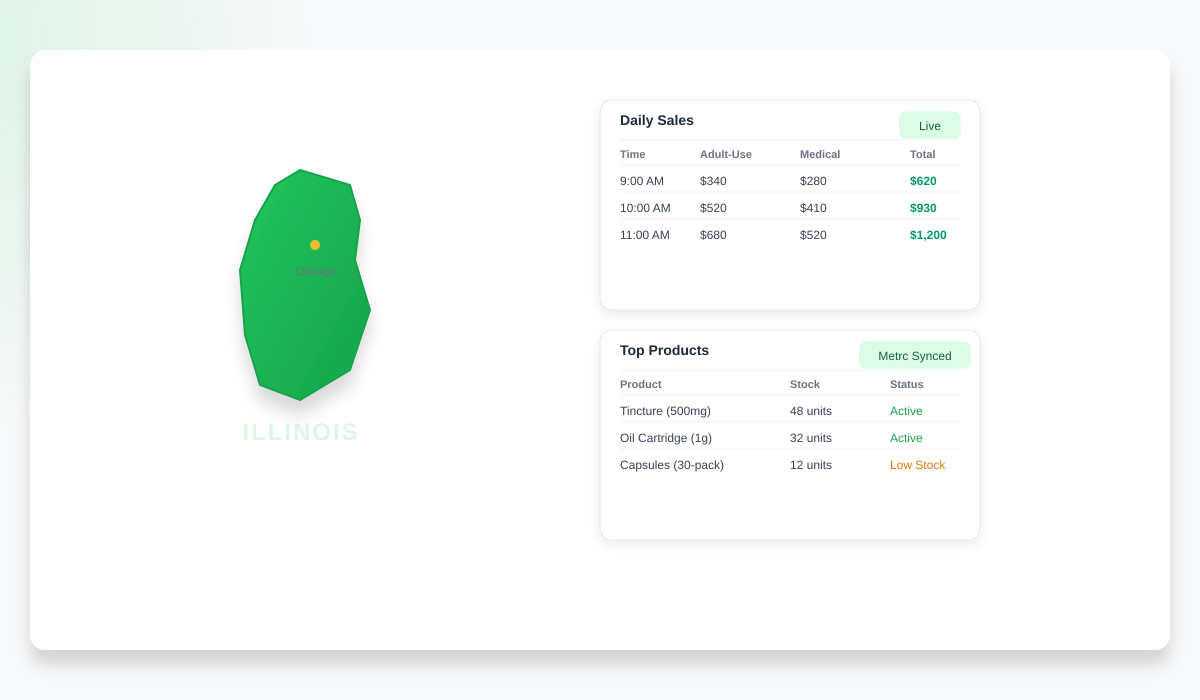
Metrc Compliance by Default. IndicaOnline’s Metrc API integration handles real-time sales logging, daily inventory reconciliation, and transfer manifests. With the state’s 2025 BioTrack-to-Metrc transition behind you, our system eliminates manual re-entry, cutting compliance errors and audit risk.
Dual Adult-Use/Medical Workflows. Your POS distinguishes adult-use from medical transactions at the point of sale: medical customers trigger registry verification and are tracked separately, and you can flag inventory reserves for medical-only products to meet supply-adequacy rules. Tax treatment auto-switches — medical purchases apply the current medical exemption (tax-exempt as of July 1, 2026), while adult-use applies the correct potency-based excise plus state and local taxes.
Potency-Based Tax Automation. Enter product potency at SKU setup, and IndicaOnline applies the correct excise tier automatically: flower ≤35% THC → 10%, flower >35% THC → 25%, infused → 20%. Stacked taxes (excise + state sales + municipal + county) are itemized on receipts, and monthly reports export to your accountant.
Multi-Location Sync. Manage multiple locations with centralized inventory and per-location compliance tracking, consolidated Metrc manifests, and separate staff, inventory, and daily reconciliation per site.
Purchase-Limit Enforcement. Resident and non-resident adult-use limits and medical limits are enforced at checkout, with oversell flags and cumulative-purchase tracking.
Inventory & Profitability Insights. Real-time inventory across locations, plus analytics by product type, customer segment, and margin. IndicaOnline tracks COGS accurately to support federal 280E documentation and audit readiness.