Run a fully Metrc-compliant medical cannabis dispensary in Alabama with IndicaOnline — the POS system built around AMCC regulations, medical-patient workflows, and Alabama’s in-person, medical-only market.
Alabama’s medical cannabis market went live in June 2026, when the state’s first dispensary opened in Montgomery after nearly five years of delays and litigation. Three more licensed operators are opening storefronts through 2026, on the way to a planned 12 locations statewide. If you hold one of Alabama’s dispensary or integrated-facility licenses — or you’re preparing for a future licensing round — IndicaOnline gives you a POS that enforces Alabama’s rules instead of a generic template with “Alabama” pasted in.
Market snapshot — as of June 2026
- 4 dispensary licensees awarded (one license stayed pending appeal); 12 dispensing locations planned
- 1 dispensary open (Montgomery, opened June 3, 2026); 3 more operators opening through summer 2026
- 300+ registered patients within days of launch; 446 patient cards issued by mid-June 2026
- 52 physicians certified to recommend medical cannabis
- New dispensary applications are not currently open — the market is limited to existing licensees
These figures move quickly in a market this new. Last updated: June 2026.
Selling Medical Cannabis in Alabama: What Operators Need to Know
Alabama legalized medical cannabis in May 2021 through the Darren Wesley ‘Ato’ Hall Compassion Act (SB 46), creating a medical-only market — recreational use remains prohibited. The Alabama Medical Cannabis Commission (AMCC) oversees all licensing, compliance, and regulatory enforcement.
Unlike states with recreational programs, Alabama’s market is deliberately constrained. The framework caps dispensary licenses at 4, with each dispensary licensee permitted to operate up to 3 dispensing sites (12 locations total). Up to 5 vertically integrated facilities may each operate up to 5 dispensing sites. Patients must be Alabama residents and hold a recommendation from a physician who carries a Medical Cannabis Certification permit. Because sales only began in June 2026, this is a genuine early-stage market — high compliance scrutiny, low transaction volume, and rapid change.
Metrc Track-and-Trace (Mandatory)
Alabama has contracted Metrc as its official statewide seed-to-sale tracking system. Every plant is tagged with a unique RFID identifier, and processed cannabis moves in tagged packages through the supply chain. Licensees pay a monthly per-license program fee plus per-tag costs. IndicaOnline integrates directly with Metrc’s API, automating tag synchronization and manifests so your team isn’t reconciling two systems by hand.
In-Person Sales Only (No Home Delivery)
Alabama does not authorize home delivery of medical cannabis to patients. Secure transporters move product between licensees (cultivator, processor, dispensary) — not to patients’ doors. Every patient purchase happens in person at a licensed dispensary. IndicaOnline’s Alabama configuration is built around in-person, medical-patient checkout — no order-ahead delivery logistics to maintain, and no workflows that could put a sale outside the rules.
Allowed Product Forms
Alabama permits a specific set of pharmaceutical-style forms: tablets and capsules, tinctures, gels and oils, topical creams, transdermal patches, suppositories, lozenges, gelatinous cubes (“gel cubes”), and inhalable liquids or oils. Raw plant material, smokable flower, vaping products, and conventional food-product edibles (gummies, baked goods, etc.) are prohibited. (In practice, gel cubes launched in a single flavor.) IndicaOnline’s product master is scoped to Alabama’s approved categories, so staff can’t accidentally ring up a prohibited item.
Taxes & Financial Planning
Alabama applies a 9% gross-proceeds tax on medical cannabis retail sales, which replaces the state’s standard 4% sales tax. Local jurisdictions may add their own taxes on top (roughly 0–8.5%), so combined rates can approach ~17.5% depending on location. Separately, licensees owe an annual privilege tax of $1.00–$1.75 per $1,000 of Alabama-apportioned net worth (minimum $100, maximum $15,000 per year). IndicaOnline applies the 9% gross-proceeds tax and any local tax automatically at checkout and produces the reports your accountant needs for the privilege-tax filing.
Alabama Dispensary License: Costs & Requirements at a Glance
| Item | Detail |
|---|---|
| Licensing authority | Alabama Medical Cannabis Commission (AMCC) |
| Application fee (non-refundable) | $2,500 |
| Annual dispensary license | $40,000 |
| Annual integrated-facility license | $50,000 |
| Dispensing sites per license | Up to 3 (dispensary licensee); up to 5 (integrated facility) |
| Ownership / residency | Alabama-resident ownership requirements apply (per AMCC rules) |
| Background check | Required for owners and employees |
| License cap | 4 dispensary licensees (12 locations); up to 5 integrated facilities |
| Current application status | New dispensary applications not open as of June 2026 |
All fees are non-refundable, and applicants must demonstrate financial stability and pass background checks. Confirm current financial thresholds and residency rules directly with the AMCC before applying, as commission rules are periodically updated.
How to Apply for an Alabama Dispensary License
Alabama’s four dispensary licenses were awarded in December 2025, and the AMCC is not currently accepting new dispensary applications. Understanding the process still matters if you’re pursuing an integrated-facility license or preparing for a future round.
Step 1: Secure a compliant location. Alabama relies on local zoning rather than a single statewide buffer rule, so confirm your municipality permits cannabis retail at your intended site.
Step 2: Prepare comprehensive documentation. AMCC applications are extensive and typically cover:
- Ownership, management, and financial documentation
- A security plan (site layout, surveillance, alarm systems)
- An operations plan (staffing, inventory management, Metrc compliance)
- Background-check clearance for all owners
Step 3: Submit through the AMCC portal. Applications go through amcc.alabama.gov, with the $2,500 non-refundable fee paid electronically.
Step 4: AMCC review and scoring. Applications are scored on financial stability, operational expertise, security protocols, and other criteria. Review typically takes several months, and — as Alabama’s history shows — awards can be contested and delayed in court.
Step 5: License award and activation. After approval, you pay the annual license fee within the AMCC’s required window, then register with Metrc, complete Metrc training, hire and train staff, and prepare to open.
How IndicaOnline Supports Alabama Dispensaries
Our POS is built around Alabama’s actual rules — not a generic template with the state name swapped in.
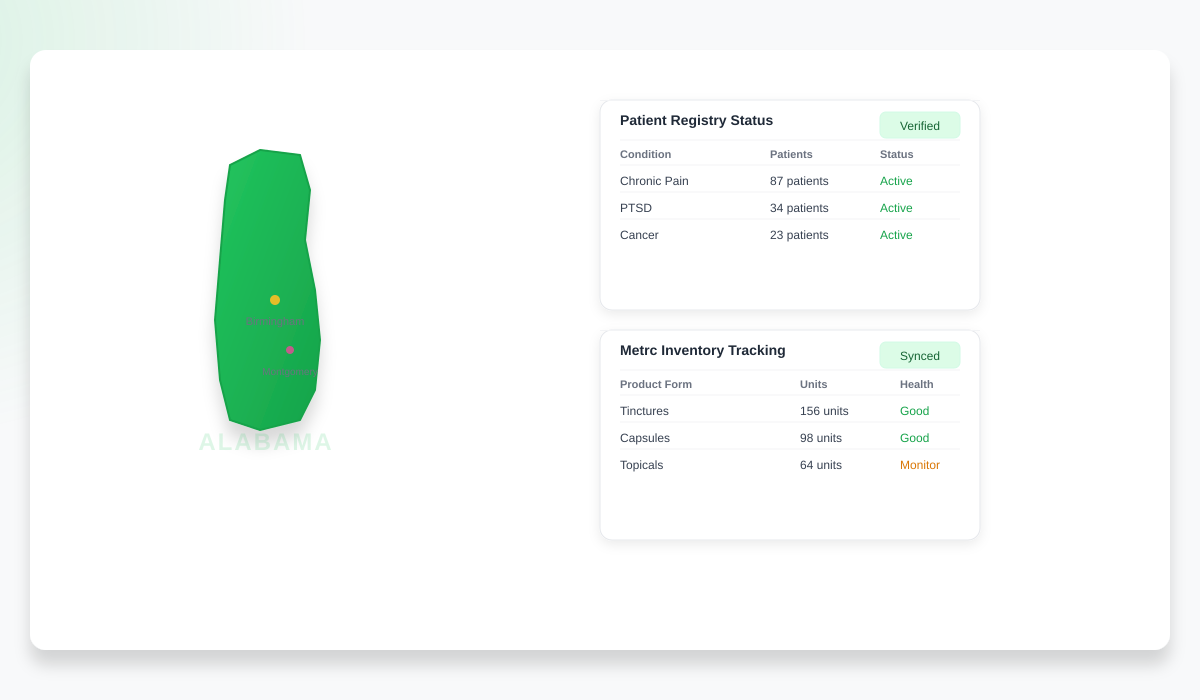
Automatic Metrc Reporting. Sales, inventory adjustments, and transfers sync to Alabama’s Metrc system, so your team spends far less time on manual reconciliation and reduces the risk of the reporting errors that trip up new operators.
Medical-Patient Workflows. IndicaOnline’s Alabama build focuses on in-person transactions: patient-registry verification, caregiver access, enforcement of purchase and daily-dose limits at the point of sale, and transaction logging that’s ready for AMCC audits.
Restricted-Product Enforcement. The system is scoped to Alabama’s approved product categories and blocks prohibited items automatically, so a non-compliant sale is far harder to make by mistake.
Multi-Location Sync. Operating up to 3 (or, for integrated facilities, up to 5) sites? IndicaOnline syncs inventory, daily reports, and Metrc manifests across every location in real time — one centralized view, with per-location compliance tracking.
Tax Automation. IndicaOnline applies Alabama’s 9% gross-proceeds tax and any applicable local tax at checkout, and exports end-of-month reports — including the figures you need for the annual privilege-tax filing — straight to your accountant.
Compliance Documentation. Staff onboarding checklists, Metrc training resources, and audit-ready transaction logs are built in, so you have documentation ready when the AMCC inspects.
Ready to Open — or Optimize — Your Alabama Dispensary?
Running a compliant medical cannabis dispensary in Alabama means navigating AMCC rules, Metrc reporting, strict product limits, and an in-person-only sales model. IndicaOnline removes the operational friction so you can focus on patient care and growth.